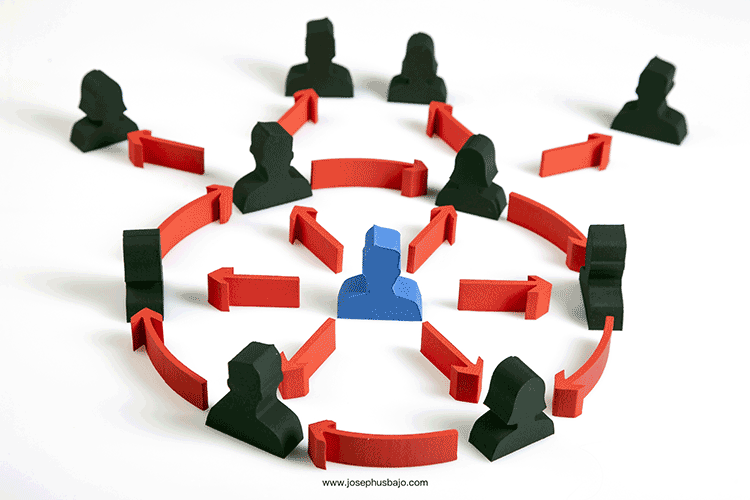
A Structured Theory of Proximity, Familiarity, and The Last Mile of Influence
Hyperlocalism did not emerge from a single campaign, trend, or isolated insight.
It emerged gradually through years of analytical observation, communication testing, audience behavior analysis, and studying the relationship between visibility and trust across digital environments.
My background is not rooted in traditional academic media theory.
It comes from accountancy, systems analysis, structured thinking, and pattern recognition.
That Distinction Matters
Because my approach toward communication was never primarily artistic or purely creative.
I naturally approached communication the same way accountants and analysts approach financial systems:
- by identifying patterns,
- measuring behavioral consistency,
- tracking variables,
- observing recurring outcomes,
- and understanding how small repeated inputs compound into large systemic effects over time.
Over the years, I became increasingly interested in one recurring contradiction within modern digital communication:
Why do certain messages, personalities, and brands create long-term influence while others disappear despite massive visibility and reach?
At first glance, modern digital systems appear highly efficient.
Platforms today can distribute content to millions of people instantly. Algorithms optimize exposure at unprecedented scale. Advertising systems continuously improve targeting precision. Analytics dashboards provide real-time performance metrics.
Yet despite this technological advancement, trust itself appears increasingly unstable.
- Audiences scroll faster.
- Attention spans become shorter.
- Virality becomes temporary.
- Engagement spikes collapse quickly.
- Visibility becomes abundant while influence becomes fragile.
This contradiction became the starting point of my inquiry.
The traditional digital model suggested that communication success was primarily driven by:
- impressions,
- audience size,
- reach,
- virality,
- and frequency of exposure.
But repeated analysis across different communication environments suggested a different pattern entirely.
Visibility Alone Was Not Producing Durable Influence. Familiarity Was.
The more I studied audience behavior, the more I observed that influence was often strongest not where communication was largest, but where communication became repeatedly embedded within a person’s surrounding informational environment.
People appeared to trust:
- what felt repeatedly present,
- what became contextually familiar,
- and what integrated naturally into their daily perception systems.
This realization became the foundation of what I now describe as:
Hyperlocalism
A structured communication theory centered on the relationship between:
- proximity,
- repeated contextual exposure,
- environmental visibility,
- territorial familiarity,
- and behavioral trust formation.

The Limitation of Mass Visibility
Modern communication systems are fundamentally optimized for scale.
Algorithms reward:
- interruption,
- novelty,
- speed,
- emotional stimulation,
- rapid engagement,
- and continuous content turnover.
The architecture of modern platforms is designed to maximize exposure velocity.
But Exposure Velocity Is Not The Same As Trust Formation
This distinction became increasingly important in my analysis.
Through studying communication patterns, campaign structures, audience behavior, and platform dynamics, I repeatedly observed that high visibility frequently failed to produce proportional behavioral loyalty.
In many situations:
- viral exposure generated temporary awareness,
- while repeated environmental familiarity generated sustained influence.
This suggested that modern communication theory may have overemphasized reach while underestimating contextual familiarity.
The industry heavily studied:
- clicks,
- conversion rates,
- engagement,
- impressions,
- and virality,
but insufficiently studied:
- environmental repetition,
- territorial familiarity,
- contextual reinforcement,
- cognitive comfort,
- and behavioral acceptance over time.
Digital communication became highly efficient at creating awareness but less effective at creating embedded trust.
This is the structural gap Hyperlocalism attempts to define.
The Familiarity Variable
One of the most important realizations in developing Hyperlocalism was understanding that familiarity should not merely be treated as an emotional byproduct of communication.
It Should Be Treated As A Measurable Strategic Variable
From an analytical perspective, familiarity behaves similarly to compounding exposure systems.
The hypothesis gradually became increasingly consistent:
Repeated contextual exposure increases behavioral trust over time.
This pattern repeatedly appeared across multiple environments:
- consumer behavior,
- digital communities,
- branding systems,
- creator ecosystems,
- political communication,
- and public perception dynamics.
The implication was significant.
Influence may not primarily operate through isolated exposure events.
Instead, influence compounds through repeated environmental reinforcement.
- A single message may create awareness.
- Repeated contextual presence creates familiarity.
- Repeated familiarity gradually lowers resistance.
- Lower resistance increases trust probability.
- Trust eventually shapes behavioral preference.
This process resembles cumulative reinforcement systems more than traditional advertising logic.
It also explains why:
- familiar personalities dominate public attention,
- familiar brands create emotional loyalty,
- and repeated exposure influences perception even without conscious awareness.
The Familiarity Economy
This became one of the foundational principles behind what I now describe as the Familiarity Economy. In this framework:
- visibility creates recognition,
- recognition creates cognitive comfort,
- cognitive comfort reduces uncertainty,
- reduced uncertainty increases trust,
- and trust influences behavior.
The modern economy increasingly rewards familiarity because modern audiences are overwhelmed by information abundance.
In Saturated Communication Environments, Familiarity Itself Becomes A Filtering Mechanism For Trust
The Last Mile of Influence
I often describe Hyperlocalism as “The Science of the Last Mile”, because it focuses on the final stage where:
- exposure becomes familiarity,
- familiarity becomes trust,
- and trust becomes action.
Traditional marketing frameworks frequently assume that awareness naturally progresses toward conversion.
But behavioral analysis suggests the process is far less direct.
There exists a critical “last mile” gap between:
- being seen,
- and being behaviorally accepted.
Many communication systems successfully achieve awareness but fail to achieve embedded psychological acceptance.
This gap is where Hyperlocalism operates.
The “Last Mile” is Not Merely About Visibility
It is about repeated contextual reinforcement inside environments where familiarity naturally compounds.
The closer communication moves toward a person’s daily informational surroundings, the stronger its behavioral influence often becomes.
In this sense, influence is not simply transmitted. It is accumulated.
Environmental Visibility as a System
One of the central concepts within Hyperlocalism is Environmental Visibility.
It refers to the phenomenon where communication gains strength through repeated presence within a person’s surrounding informational environment.
This is fundamentally different from interruption-based advertising.
Traditional advertising inserts itself into attention.
Environmental Visibility Embeds Itself Into Familiarity
Rather than relying solely on isolated advertisements or temporary campaigns, influence becomes reinforced through:
- repeated contextual exposure,
- environmental consistency,
- territorial relevance,
- and continuous perceptual reinforcement.
From a systems perspective, this creates:
- lower cognitive resistance,
- stronger memory retention,
- increased recognition speed,
- higher trust probability,
- and deeper behavioral familiarity over time.
The process behaves similarly to cumulative exposure systems found in behavioral psychology and reinforcement dynamics.
Repeated familiarity gradually transforms visibility into perceived legitimacy.
The important distinction is that this transformation often occurs subtly.
People rarely notice familiarity forming in real time.
But over long periods of repeated contextual exposure, familiarity begins functioning as a trust infrastructure.
Hyperlocalism as a Communication Framework
Hyperlocalism should not be misunderstood as merely “local marketing.” It is significantly broader than that.
It is an attempt to formally study:
- proximity-based influence,
- territorial attention systems,
- contextual trust formation,
- environmental visibility,
- and familiarity as strategic infrastructure.
The framework intersects multiple disciplines:
- communication theory,
- behavioral economics,
- marketing systems,
- sociology,
- network effects,
- information flow,
- digital attention mechanics,
- and reinforcement behavior.
At its core, Hyperlocalism attempts to answer a larger question:
How does repeated contextual presence shape human trust inside modern communication environments?
This question becomes increasingly important as information systems continue becoming more saturated, decentralized, and behaviorally fragmented.
The Future of Influence
As digital communication environments continue becoming increasingly crowded, attention alone becomes less valuable.
The next competitive advantage may no longer belong to those who generate the largest reach.
It may belong to those who most effectively engineer:
- familiarity,
- contextual relevance,
- environmental visibility,
- territorial trust,
- and repeated behavioral reinforcement.
The future of influence may increasingly depend on:
not merely being visible,
but becoming repeatedly familiar within meaningful environments.
This is the central premise behind Hyperlocalism.
And this is why I believe the future of communication will increasingly revolve around:
Not Mass Exposure, But Proximity-Driven Familiarity Systems
Hyperlocalism is my attempt to define, structure, systemize, and analytically explain that emerging reality.